

How to Prepare for Your First Home Care Patient as an LPN
- August 2, 2026
- 9 min read
LICENSED PRACTICAL NURSE
Table of Contents
- 1. What No One Tells You Before Your First Home Care Visit
- 2. Read the Care Plan Before You Leave the House
- 3. Stock and Check Your Nursing Bag
- 4. Know Your Route and Plan for the Unexpected
- 5. Make the Right First Impression at the Door
- 6. Do a Home Safety Walkthrough on Visit One
- 7. Document Accurately and the Same Day
- 8. Know When to Escalate and How to Do It
- 9. Where to Find LPN for Home Care Patient Roles in NYC
- 10. Frequently Asked Questions
- 11. Conclusion
Home care is a different discipline than most LPNs train for. The clinical skills transfer. The mindset does not always. When you step into a patient’s home for the first time, you are not walking into a controlled environment with backup around the corner. You are walking into someone’s private space, working independently, and making real-time judgment calls that matter immediately. Being an effective LPN for home care patients starts well before you knock on the door. It starts with preparation. This guide covers exactly what that looks like.
1. What No One Tells You Before Your First Home Care Visit
Most LPNs enter home care expecting a lighter version of clinical nursing. What they find is something more demanding in a different way. The patient load is smaller, but the autonomy is larger. There is no charge nurse to flag down, no supply room down the hall, and no shared team rhythm to fall back on.
As an LPN for home care patients, the environment itself becomes a variable you have to manage. Homes vary in cleanliness, layout, lighting, and safety. Family members may be present during care and may have opinions about it. Supplies that should be stocked sometimes are not. Equipment that should be functioning sometimes is not.
None of this is a reason to hesitate. It is a reason to arrive prepared. The nurses who adjust fastest to home care are the ones who treat preparation as part of the job, not a task that ends once the shift starts.
2. Read the Care Plan Before You Leave the House
The care plan is your primary clinical document. Not a reference you skim in the car. Not something you open after you arrive. Read it fully before you leave for the visit.
A thorough review tells you:
- The patient’s primary diagnosis and relevant history
- Current medications, dosages, timing, and administration routes
- Specific nursing tasks assigned to each visit
- Known allergies, contraindications, and sensitivities
- Your supervising RN’s contact and escalation protocol
- Family members or caregivers involved in the patient’s daily care
If anything in the care plan is unclear, call your coordinator or supervising RN before you go. Arriving with unresolved questions puts you in a position where you are problem-solving in front of the patient instead of delivering care with confidence. That distinction matters, both for outcomes and for the trust you are trying to build from visit one.
3. Stock and Check Your Nursing Bag
Your nursing bag is your mobile supply station. For every LPN for home care patients, it should be fully stocked, organized, and checked before every visit, not just before your first one.
Standard bag contents include:
- Stethoscope and blood pressure cuff
- Thermometer and pulse oximeter
- Nitrile gloves in multiple sizes
- Wound care supplies appropriate to the care plan
- Alcohol wipes, hand sanitizer, and PPE
- Penlight and small scissors
- Documentation forms or tablet for electronic charting
- Contact list including supervising RN, coordinator, and emergency numbers
Running out of a supply mid-visit, or arriving without the right glove size for a wound dressing, creates avoidable problems in a setting where there is no supply closet to fall back on. Make the bag check a non-negotiable step before every visit.
4. Know Your Route and Plan for the Unexpected
This step is practical and frequently underestimated. According to the Bureau of Labor Statistics, LPNs and LVNs who work in home health travel to patients’ residences, and consistent, reliable presence is a core expectation of the role.
Plan your route the night before, not while you are already running late.
Factor in Urban Variables
In New York City, route planning means more than checking Google Maps. Factor in subway delays, building access procedures, elevator wait times in high-rise buildings, and street parking conditions in dense neighborhoods. What looks like a fifteen-minute trip can become a forty-minute one on the wrong morning.
Build a Buffer Into Your Schedule
Arriving five minutes early signals professionalism. Arriving five minutes late on a first visit starts the relationship on the back foot. Patients and families form impressions quickly, and punctuality communicates that you take the assignment seriously before you have said a single word.
5. Make the Right First Impression at the Door
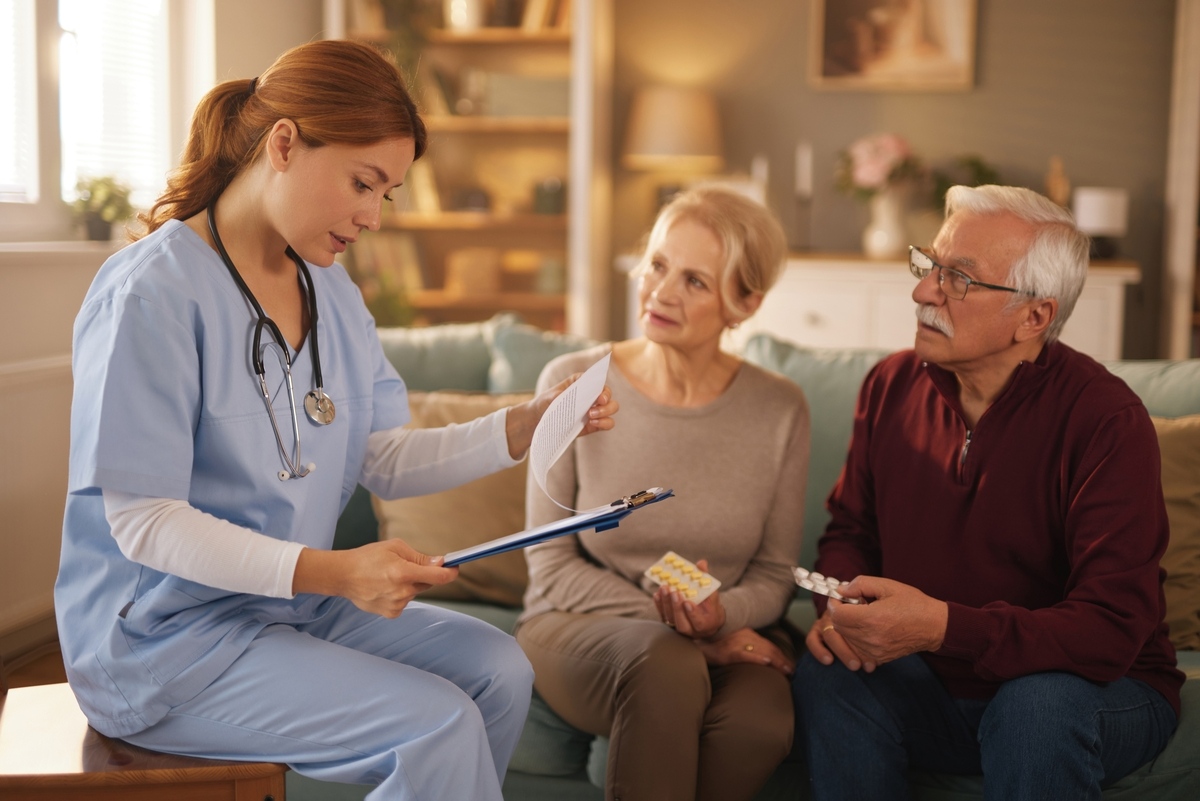
The first few minutes of a first visit carry more weight than most nurses expect. For elderly patients or those managing serious conditions, having a nurse enter their home is both a comfort and an adjustment. How you carry yourself at the door sets the tone for every visit that follows.
Introduce Yourself Clearly
State your name and your role as soon as the door opens. Do not assume the patient was briefed on who to expect or when.
Explain Before You Begin
Walk the patient through what you will be doing during the visit before you start. People cooperate more willingly with care they understand and less willingly with care that happens to them without explanation.
Ask How They Prefer to Be Addressed
This is a small gesture that signals real respect. Using a patient’s preferred name from the first visit is one of the fastest ways to establish comfort.
Acknowledge Family Members Present
If family members are in the room, include them appropriately from the start. Families who feel acknowledged are far easier to work with than families who feel sidelined.
6. Do a Home Safety Walkthrough on Visit One
A home safety assessment on your first visit is standard practice and a professional responsibility. According to the Centers for Disease Control and Prevention, falls are the leading cause of injury among older adults, and the home environment is where most of those falls occur. Identifying hazards early is part of what makes home care nursing different from, and in some ways more preventive than, clinical care.
On your first visit, look for:
- Loose rugs, cluttered walkways, or uneven flooring
- Poor lighting in hallways, stairwells, and bathrooms
- Absence of grab bars or non-slip mats in the bathroom
- Medications stored improperly or out of reach
- Medical equipment that appears damaged or incorrectly positioned
- Visible fire or carbon monoxide detectors and their status
Document what you find and report significant concerns to your supervising RN after the visit. Your role is not to fix the environment. It is to identify what needs attention and communicate it to the team.
7. Document Accurately and the Same Day
Documentation in home care carries real weight because you are the only clinician present during the visit. What you record is the only clinical record of what happened in that home. Gaps in documentation create gaps in patient care and gaps in your own professional protection.
After every visit, document:
- Vital signs with exact time recorded
- All nursing tasks completed and patient response to each
- Any changes in condition, behavior, or home environment
- Medications administered with dosage, route, and time
- Concerns raised by the patient or family during the visit
- Any safety issues or incidents observed
Submit documentation the same day, not the following morning. Delayed charting introduces errors in recall and creates questions about what actually happened during the visit. Most agencies using electronic health records expect same-day submission, and for good reason.
8. Know When to Escalate and How to Do It
Independent judgment is one of the defining features of working as an LPN for home care patients. In a hospital, escalation is built into the structure. In home care, you are the one who decides when a call needs to be made, and making that call at the right moment is one of the most important skills in the role.
Escalate to your supervising RN immediately when you observe:
- Vital signs significantly outside the patient’s documented baseline
- New or worsening symptoms not described in the care plan
- Signs of a fall, injury, or accident since the last visit
- Refusal of critical medications or treatments
- Evidence of abuse, neglect, or unsafe living conditions
- Any situation where you are genuinely unsure how to proceed
Never manage a situation beyond your scope to avoid making a call. Escalating when something is uncertain is not a sign of inexperience. It is exactly what professional judgment looks like in a setting where the stakes are real and the backup is not in the next room.
9. Where to Find LPN for Home Care Patient Roles in NYC
If you are ready to apply what you have read here, positions are open now across New York City. Whether you are looking for assignments close to home or open to working across boroughs, the demand for qualified LPNs in home care is steady and growing.
Visit our LPN jobs NYC page for a full overview of available roles, or check LPN jobs in the Bronx if you are based in the borough and want assignments nearby. For a fuller picture of what the day-to-day role actually looks like once you are placed, our guide on working as an LPN in home care is worth reading before your first visit.
10. Frequently Asked Questions
Do I need home care experience before taking my first assignment?
No. Nursing Done Right welcomes LPNs who are new to home care. A detailed care plan, orientation, and access to a supervising RN are provided to support you through your first visits.
What do I do if a patient refuses care during a visit?
Document the refusal clearly, note the reason if the patient provides one, and contact your supervising RN to report it. Never force care or omit documentation because a patient declines.
How many patients will I see per day in home care?
It depends on your assignment type. Long-term private duty cases typically involve one patient per shift. Visit-based cases may include several patients per day. Your coordinator will explain the structure before your first visit.
What happens if I cannot reach my supervising RN during a visit?
Follow your agency’s escalation protocol. If the situation is a medical emergency, call 911 first. Most agencies have an on-call coordinator available outside business hours for non-emergency situations.
Is home care nursing safe?
Home care carries different risks than hospital nursing. Performing a safety walkthrough, following your care plan closely, and knowing your escalation contacts are the three most effective ways to manage those risks professionally.
11. The First Visit Sets Everything That Follows
Preparation is not a formality for an LPN for home care patients. It is the foundation that every patient relationship, every clinical decision, and every successful visit is built on. Read the care plan. Check the bag. Know the route. Introduce yourself well. Assess the environment. Document the same day. Escalate when something is wrong. These habits are simple individually, but together they define what professional home care nursing actually looks like in practice.
Key Takeaways
- Read the full care plan before leaving for the visit, not after you arrive
- A fully stocked nursing bag checked before every visit prevents avoidable problems in the field
- Punctuality on a first visit communicates professionalism before a single word is spoken
- A home safety walkthrough on visit one is a clinical responsibility, not an optional step
- Same-day documentation protects the patient and protects you
- Escalating when uncertain is not weakness — it is exactly what good judgment looks like in home care
READY TO TAKE YOUR FIRST HOME CARE ASSIGNMENT?
Nursing Done Right places LPNs in rewarding home care positions across New York City and Westchester County. If you are prepared, compassionate, and looking for work that actually makes a difference, we want to hear from you.
Disclaimer: This article is for general informational purposes only and does not constitute clinical practice advice. All nursing care should follow the supervising RN or physician’s direction and your agency’s established protocols. Preparation steps should be adapted to each patient’s specific care plan and individual needs.